Automating Dental Patient Scheduling with AI Assistant
 AuthorМария Лебедева
Contents
- Why reminder calls no longer work
- What an AI assistant actually does
- Integration with CMS and CRM — where most implementations fail
- Real numbers: what changes after launch
- Voice or text — which format to choose
- Implementation stages: 8–14 weeks from audit to production
- Checklist: is your clinic ready for implementation
A dental clinic administrator spends up to 40% of their working day on phone calls — and one in five patients still doesn't show up. Money is spent, the chair sits empty, the dentist waits.
Manual phone-based scheduling creates a bottleneck where both patients and revenue are lost. An AI assistant closes that bottleneck not by replacing the administrator, but by working around them: absorbing routine tasks and leaving complex cases to the person.
Why reminder calls no longer work
Dental practices run on schedules. An hour in the chair is a fixed unit of revenue that cannot be "made up later in the evening." If a patient doesn't show, that hour is gone.
Scheduling and appointment confirmation is not a single task — it is dozens of parallel micro-tasks: an incoming call, a reply on Instagram, rescheduling a visit, finding an available slot with a specific dentist, sending a reminder for tomorrow, processing a cancellation. During peak hours, the administrator simply cannot call everyone — and some patients just forget to come.
According to Medesk data, clinics relying on manual reminders maintain a no-show rate of 20–25%. After introducing automated reminders, that figure drops to 12–15%. A difference of 10 percentage points is a direct revenue loss every working day — not an abstract "process efficiency" metric.
The situation is compounded by the fact that patients no longer want to call. The 25–40 age group prefers messengers, those 40 and older prefer phone calls, and parents of young patients write on WhatsApp in the evening. A single scheduling channel cuts off half of demand before it ever reaches the administrator.
What an AI assistant actually does
Here is a breakdown of the functionality without the marketing wrapper.
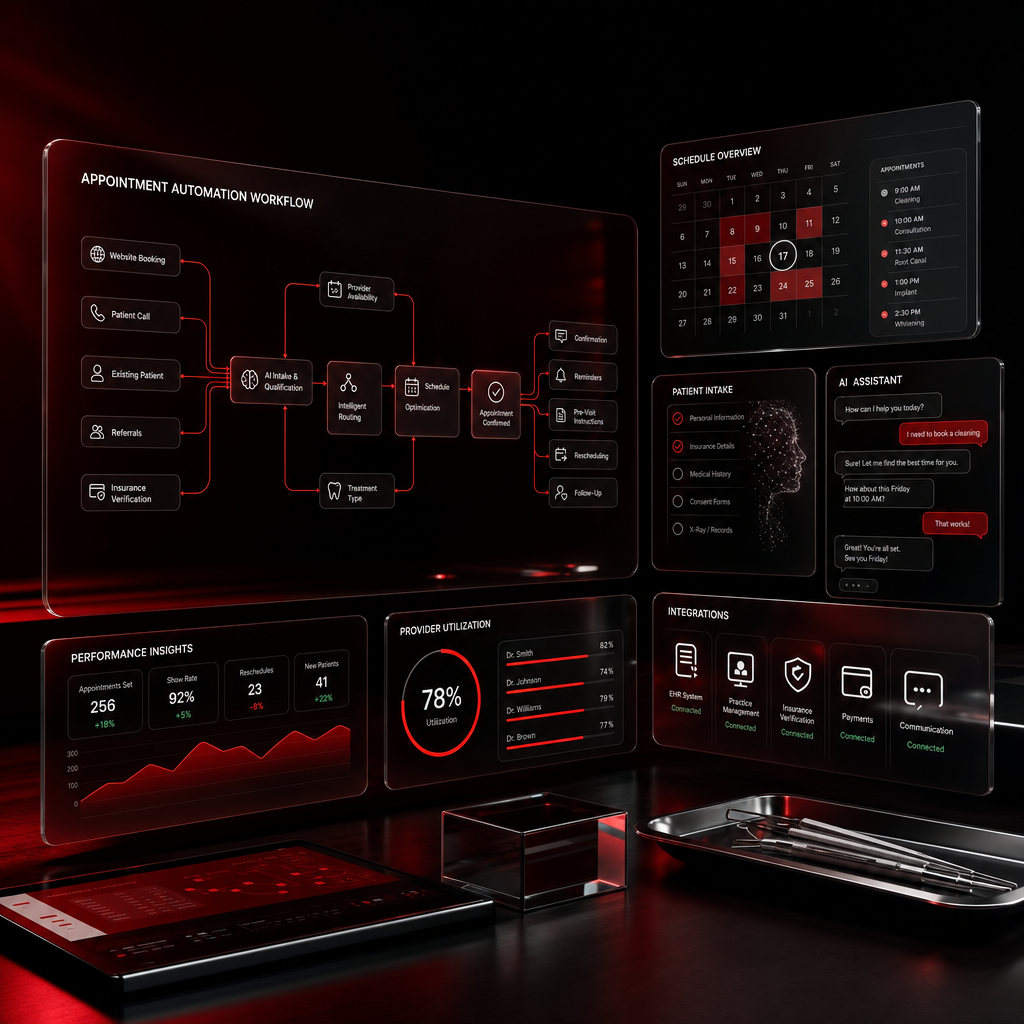
Handling incoming requests. The assistant works simultaneously across multiple channels: a voice bot on incoming calls, WhatsApp, Telegram, a website widget, and an Instagram lead form. A patient types "I'd like to book a cleaning" — the assistant clarifies the branch, a convenient date, the preferred dentist, and offers available slots from the live schedule.
Booking and confirmation. The assistant does not forward a request to the administrator — it creates the appointment directly in the clinic management system (CMS), linked to the patient's record. For a new patient, it creates the record and collects the required fields: full name, phone number, and consent to personal data processing.
Reminders 24 hours and 2 hours before the appointment. Text or voice — based on the patient's preference. If the patient replies "I can't make it," the assistant immediately offers to reschedule and releases the slot, which becomes visible in the booking system instantly.
Cancellation handling. This is the scenario where clinics lose the most money. If a patient cancels with a day's notice, the assistant immediately notifies patients on the waiting list at the moment of cancellation.
According to the Accenture Health Technology Report 2024, the average time an administrator spends processing a single appointment is 4–6 minutes; for an AI assistant, it is under 1 minute. With a volume of 50 appointments per day, that amounts to 3–4 hours returned to the administrator — time that can go toward welcoming patients at reception, handling complex cases, and upselling hygiene or orthodontic services.
For more detail on how we design these workflows, see the AI assistant case studies section.
Integration with CMS and CRM — where most implementations fail
If the AI assistant is not connected to the CMS schedule, it becomes a sophisticated notepad: it communicates well but cannot see real slots or write to patient records. The administrator transfers data manually, and any time savings disappear.
The integration point is the medical system's API. In Russian dental practices, the three most common stacks are 1C:Medicine (Dentistry), Medesk, and Dental4Windows. The first two have open or partner APIs; the third is more complex and requires a middleware layer.
The Russian CMS market was valued at 18–20 billion rubles in 2024, growing at 12–15% per year (CNews Analytics). Vendors are opening their APIs right now to avoid being left behind by the wave of AI-driven scheduling. The window for custom integration is the next 12–18 months, while solutions are still adapting to the clinic rather than the other way around.
The second layer is CRM. A patient booking is the beginning of the funnel, not its end. The CRM captures visit data, the source of the inquiry, cancellations, and post-visit reviews. Without this connection, the clinic cannot see patient lifetime value or build follow-up touchpoints: reminding a patient about professional hygiene in six months, offering an orthodontic consultation for their child, or sending a message a month after implant placement.
We address CMS and CRM integration during the technical audit phase — it is part of our custom development service.
Real numbers: what changes after launch
No-show rate. Down from 20–25% to 12–15%, according to Medesk. For a clinic with monthly revenue of 5 million rubles and an average ticket of 6,000 rubles, this translates to 400–500 thousand rubles recovered each month — without expanding the medical team or increasing traffic.
Administrator workload. Reduced by 40–60%, according to Accenture. In practice: a two-branch clinic experiencing growth in inquiries redistributes workload instead of hiring a third administrator. One FTE in Moscow costs 600–800 thousand rubles per year including taxes.
Response time. From "we'll call you back within the hour" to a response within the first 10 seconds — 24/7, including evenings and weekends. Up to 30% of inquiries at private clinics arrive outside call center hours; previously, those requests were simply lost.
Payback period. Based on the case of the Zubnaya Feya (Tooth Fairy) network (12 branches) — approximately 4 months after launching a voice assistant, with a 35% reduction in call center costs. These figures align with the broader market picture.
Voice or text — which format to choose
Voice bot. Handles incoming calls — the primary channel for patients aged 45 and older and for urgent requests ("toothache, I need to come in today"). Requires PBX integration and well-developed scripts tailored to local speech patterns. Less effective at handling atypical scenarios such as lengthy complaints.
Text chatbot (WhatsApp, Telegram, website widget). Covers the 25–45 age group and parents who book during their lunch break. The patient sees available slots as a list and selects one themselves. Some patients do not use messengers to book medical appointments.
Hybrid model. A voice bot for incoming calls plus a messenger bot on the website and social media. More complex to design, but delivers maximum reach across all age segments. According to Accenture, either format alone reduces administrator workload by 40–60%; the hybrid model produces the best results in terms of converting inquiries into completed visits.
A practical rule of thumb: if 70% or more of bookings come through phone calls, start with a voice bot. If the main traffic comes from Instagram and the website, start with a messenger bot. The hybrid model is justified from the third branch onward.
Implementation stages: 8–14 weeks from audit to production
Stage 1. Scheduling process audit (1–2 weeks). We measure: how many inquiries per week, across which channels, the current no-show rate, and how much time the administrator spends on calls. Without these figures, ROI cannot be calculated.
Stage 2. Scenario design (2–3 weeks). We script the dialogues: new patient booking, repeat booking, rescheduling, cancellation, response to a pricing question, response to a complaint. For a dental practice, this typically produces 15–25 scenarios — more than it seems at the outset.
Stage 3. CMS and CRM integration (3–5 weeks). The highest-risk stage. This is where "grey" data surfaces in the schedule: slots with typos, duplicate patient records, unsupported phone number formats. Some data must be cleaned before the assistant can be connected.
Stage 4. Pilot on a single branch (2 weeks). We launch the assistant on 20–30% of incoming traffic, with the remainder handled by the administrator. We compare metrics and refine scenarios. This stage addresses resistance from administrators: they see that the assistant takes over routine work, not their role.
Stage 5. Scale-up (1–2 weeks). Full traffic is handed over to the assistant, and additional branches are connected.
A separate layer involves compliance with Russian personal data legislation and medical confidentiality requirements. Data storage, encryption, and consent flows are structured in accordance with Russian regulations from day one. Across 281 projects delivered by the Tantal team in various industries — see our case studies — this methodology is well established. Dental practices are neither the first nor the second sector where we have applied it.
Checklist: is your clinic ready for implementation
Eight questions for self-assessment:
1. More than 60% of bookings come through the phone? — the automation potential is high. 2. No-show rate above 15%? — the clinic is losing revenue every day that an assistant could recover. 3. Does the CMS have an open or partner API? — integration is achievable within 3–5 weeks. 4. Is the physician schedule digitized? — if slots are in Excel or on paper, the system needs to be put in order first. 5. Is there a CRM with post-visit patient data? — without it, the assistant handles bookings but does not work with LTV. 6. More than 20% of inquiries arrive outside working hours? — this is the primary source of lost revenue. 7. Two or more administrators handling calls? — payback period is around 4–6 months. 8. Three or more branches? — ROI turns positive within six months.
—
Tantal is a Skolkovo resident with 10+ years in the market and 253 specialists on staff. We build AI assistants designed for Russian regulatory requirements and for the real CMS stacks currently used in dental practices. Submit a request for a free scheduling process audit — within a week, we will show you where your clinic is losing patients and what ROI automation will deliver in your specific case.
Was this article helpful?
Thanks for the feedback!
Read also
Dental Leads: 127–142 from 500K ₽ Media Plan
127–142 leads per month with a budget of 500,000 ₽ and an average CPL of 3,670 ₽ — this is the baseline media plan forecast for a dental clinic in Moscow. These figures…
AI Voice Bot for Auto Shop: Stop Missing Calls
Up to 40% of inbound calls to auto repair shops come in outside business hours — according to Calltouch data. Most of them go unanswered. You have already paid for…

How an AI Assistant Replaced a Manager at Video Studio
A video studio in Bali was receiving booking requests around the clock — from Instagram, Telegram, and WhatsApp, in five languages. Managers couldn't keep up, and…

How an AI Assistant Handled 10,000+ Tickets Per Day
KupiCode was processing thousands of customer requests daily — payment issues, order statuses, refunds. The support queue kept growing, and average response time…

How to Implement AI in Business: 7 Steps to Launch
Eight out of ten AI projects at large and mid-sized companies never reach production. Among those working with a specialized contractor, the failure rate drops to three…

AI actor Tilly Norwood has released the worst song I’ve ever heard
AI Actress Tilly Norwood Releases the Worst Song Ever Heard Recently, Tilly Norwood , an AI actress, presented her new song, which turned out to be a heartfelt cry on…
