AI Voice Bot for Auto Shop: Stop Missing Calls
 AuthorДмитрий Соколов
Contents
- When a customer calls and you're not there: why this is a structural problem
- How a voice AI bot differs from an answering machine
- How it works: the flow from call to confirmed appointment
- Numbers from real deployments
- Common objections — and honest answers
- Vendor selection checklist
- How to launch a bot: four steps without a lengthy specification process
Up to 40% of inbound calls to auto repair shops come in outside business hours — according to Calltouch data. Most of them go unanswered. You have already paid for advertising, SEO, and reputation-building to get that person to dial your number. Ten minutes later, they have booked an appointment with a competitor.
A voice AI bot closes that gap without expanding your team or running night shifts. Below is exactly how it works in an auto repair context, what numbers real deployments show, and what to look for when choosing a vendor.
—
When a customer calls and you're not there: why this is a structural problem
Open your call tracking report for the last 30 days and look at the time distribution. The majority of inquiries do not come in between 9 and 6 — they come in the evening after work, on Saturday afternoon, and on Sunday morning. Those are exactly the calls that most often go nowhere.
What does a person do when their car won't start in the morning? They open the first three listings in 2GIS or Yandex Maps and call down the list. Whoever picks up first and gives a clear appointment time gets the customer. The decision is made within ten minutes of the call.
"We'll call you back in the morning" does not work. By morning, the customer is either already on a lift at the shop next door or has lost the sense of urgency. The money spent on acquiring that call — paid social, search ads, SEO — is gone. And this happens every week, on a predictable schedule.
—
How a voice AI bot differs from an answering machine
The main concern for business owners is: "It's a robot — customers will hang up within five seconds." That concern is understandable, but it applies to answering machines from 2010 — "leave a message after the beep." A modern voice bot is a different technology entirely.
The bot holds a conversation. It greets the caller in a voice that is difficult to distinguish from a human one, asks for the make and model of the vehicle, clarifies the nature of the problem, offers three available appointment slots, confirms the customer's choice, logs the booking in the CRM, and sends the customer an SMS — all within a single call, with no transfers and no "please hold for an operator."
The Russian conversational AI market is estimated at 18–22 billion rubles in 2025 and is growing at 35–40% per year, according to J'son & Partners Consulting and the CSR. The primary driver is voice bots for small and mid-sized businesses: auto repair shops, medical centers, beauty salons, and tire shops. Companies with 10–50 employees that cannot afford a night-shift administrator but can afford a bot.
The distinction is fundamental: an answering machine takes a message; a bot converts the caller into a booking.
—
How it works: the flow from call to confirmed appointment
Saturday, 10:30 PM. A customer is driving back from the countryside and notices the car is pulling to the left. They open 2GIS, see your shop at the top of the results, and call.
The bot answers after the second ring: "Leningradsky Auto Service, good evening. How can I help you?" Customer: "My car is pulling to one side — I need a wheel alignment." Bot: "Could you tell me the make and model?" — "Toyota Camry, 2018." Bot: "The next available slot for a wheel alignment is tomorrow, Sunday, at 11:00 AM or 2:30 PM. Which works better for you?" — "Let's go with 11." Bot: "I've booked you in for Sunday at 11:00 AM — wheel alignment, Toyota Camry. I'll send you an SMS with the confirmation and address."
The call takes 90 seconds. The booking is logged in AmoCRM or Bitrix24 with the tag "bot, after hours." On Monday morning, the administrator sees a confirmed appointment — the customer is already on their way.
According to Juniper Research, the conversion rate of a missed call into a booked appointment via a voice bot in the automotive and service maintenance segment reaches 25–30%. Out of 100 calls that previously went unanswered, 25–30 turn into real bookings — without adding staff or outsourcing to a call center at 80 rubles per minute.
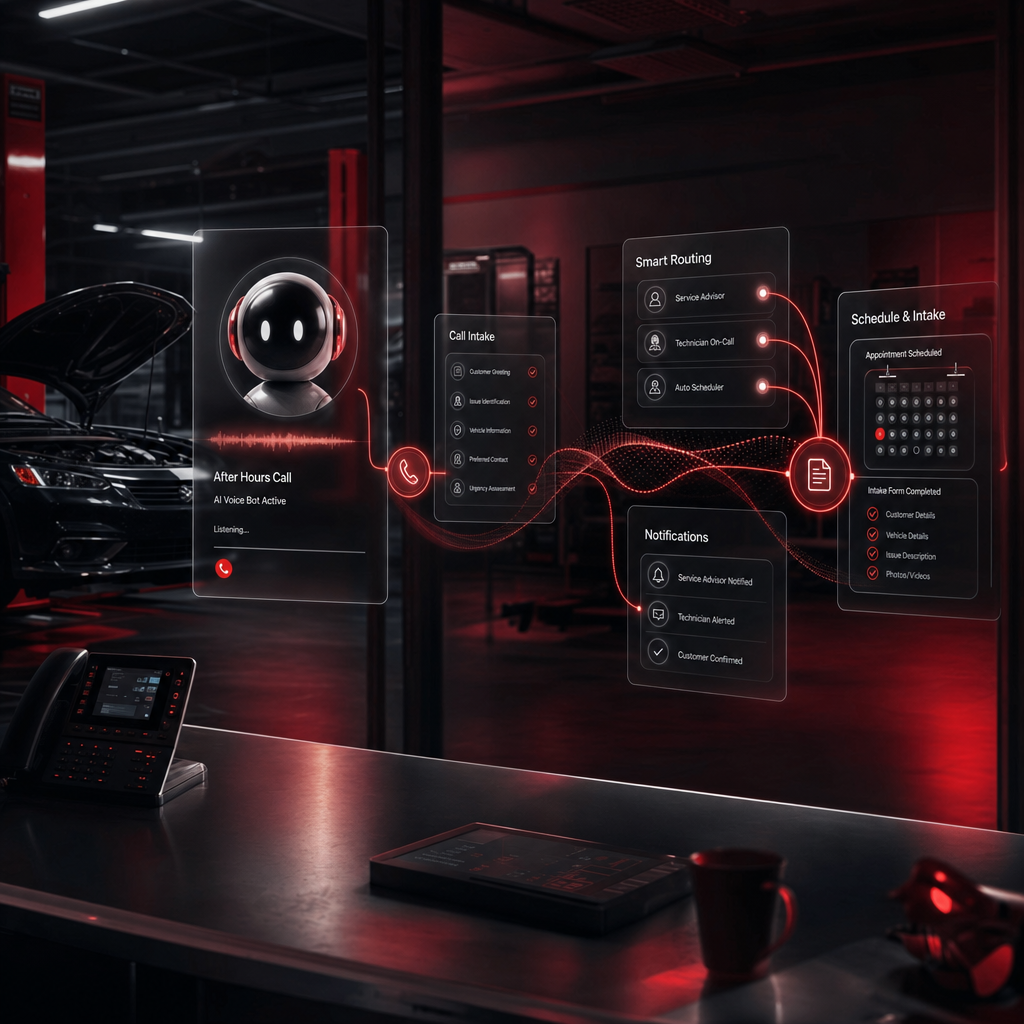
The bot does not replace your staff. It works in the window when your staff physically cannot be there — at night, early in the morning, on weekends, or when the front-desk administrator is occupied with a customer. By morning, the administrator finds a queue of bookings, as if a night-duty receptionist had been taking calls all along.
—
Numbers from real deployments
Zvonobot's published case studies show that deploying a voice bot in auto repair shops reduces lost inbound inquiries by 60–70% and pays for itself within 2–4 months at an average booking value of 3,000 rubles.
Naumen's 2024–2025 case studies paint a similar picture: auto repair shops that activated a 24/7 voice bot increased the number of handled inquiries by 30–45% without growing their headcount. The cost of handling a single inquiry drops by a factor of 3–5 compared to a live operator.
A straightforward calculation. Average booking value: 5,000 rubles; margin: 40%, or 2,000 rubles per booking. The bot recovers 3 calls per week that previously went unanswered — that is 12 bookings per month. Additional margin: 24,000 rubles. Over a year: 288,000 rubles. The cost of deploying a basic voice bot is 50,000–150,000 rubles upfront plus a monthly subscription of 10,000–25,000 rubles. Payback period: 2–4 months, after which everything is incremental gain.
For a shop handling 200 or more calls per month, a realistic outcome is 8–10 recovered calls per week. That translates to hundreds of thousands of rubles in additional revenue per quarter.
The key point in these numbers: you are not cutting administrator salaries. You are recovering money you have already spent on acquiring the customer. The bot closes the final stretch of the funnel where the leak was previously happening.
—
Common objections — and honest answers
"Customers won't talk to a robot." When you call your bank, you speak to a bot. When you book a taxi through an app, the confirmation comes from a bot. Nobody switches providers because of that. Modern voice AI recognizes Russian speech with 92–96% accuracy. Some customers do not realize they spoke with a bot — until the administrator follows up in the morning to confirm the details.
"Our pricing is complex — the bot won't be able to quote a price." The bot is not supposed to quote an exact price. Its job is to book the customer in for a diagnostic or a specific service. Pricing for complex work is always discussed by the service advisor after the inspection — that has always been the case, even with a live administrator. The bot captures the make, the problem, the time slot, and the contact details. Everything beyond that is handled by a person.
"Integration will take too long." A basic voice bot for an auto repair shop is built in 2–3 weeks. One day for a conversation brief on the call script. Five to seven days for configuration and integration with the CRM and telephony. One week for test calls and refinements. During the first month, the bot learns from real conversations and becomes more accurate.
"I already have a CRM and IP telephony." The voice bot does not replace your CRM — it writes to it. It does not replace your telephony — it integrates with it. AmoCRM, Bitrix24, Megaplan, Mango Office, UIS — all of these integrate via standard APIs.
—
Vendor selection checklist
Six criteria worth comparing across proposals.
1. Russian speech recognition quality. Request a test call. Speak with an accent, with background noise, and interrupt the bot. A solid bot will ask for clarification — and will not get stuck in a loop of "I didn't catch that, please repeat."
2. Integration with your CRM and telephony. Clarify before signing: via API, webhooks, or a ready-made connector? Who is responsible for the integration — you or the vendor?
3. Scenario flexibility. Can you update responses and add services without touching the code? Good platforms provide a scenario editor that an administrator can learn in an hour.
4. Call analytics. Recordings of every conversation, text transcripts, topic tags, and conversion reports. Without analytics, you will not know where the bot is losing customers.
5. Time to deployment. A basic scenario should be live within three weeks. If a vendor says "five months for a pilot," the team does not have ready-made templates for your industry.
6. Who stands behind the product. How long has the team been in the market, are there public case studies, and who answers questions — a sales manager or an engineer. Tantal has been operating for 10 years, has delivered 281 projects, and has 253 specialists on staff. View case studies in the AI assistant section.
—
How to launch a bot: four steps without a lengthy specification process
Step 1 — a 30-minute conversation. We look at your call funnel: how many inquiries come in per month, what share arrives outside business hours, which CRM you use, which telephony system you have. We identify where the leak is.
Step 2 — a loss calculation. Using your numbers, we calculate how much revenue you are leaving on the table each month from missed calls. A specific figure based on your average booking value and margin.
Step 3 — a basic scenario in two weeks. We build a minimum viable bot: booking for core services, integration with your CRM, SMS dispatch. We launch it on a portion of your inbound traffic.
Step 4 — refinement based on live calls. During the first month, we listen to recordings, add scenarios, and expand the vocabulary. Within 4–6 weeks, the bot is converting 25–30% of missed calls into bookings.
Write to sales@tantal.ai or call +7 (495) 799-08-77. In 30 minutes, you will have a calculation of how many calls you are losing right now.
The most expensive call is the one you already paid for through advertising — and never answered.
Was this article helpful?
Thanks for the feedback!
Read also
Dental Leads: 127–142 from 500K ₽ Media Plan
127–142 leads per month with a budget of 500,000 ₽ and an average CPL of 3,670 ₽ — this is the baseline media plan forecast for a dental clinic in Moscow. These figures…

Automating Dental Patient Scheduling with AI Assistant
A dental clinic administrator spends up to 40% of their working day on phone calls — and one in five patients still doesn't show up. Money is spent, the chair sits…

How an AI Assistant Replaced a Manager at Video Studio
A video studio in Bali was receiving booking requests around the clock — from Instagram, Telegram, and WhatsApp, in five languages. Managers couldn't keep up, and…

How an AI Assistant Handled 10,000+ Tickets Per Day
KupiCode was processing thousands of customer requests daily — payment issues, order statuses, refunds. The support queue kept growing, and average response time…

Voice Robot for Telemarketing Calls: How It Pays Off in Small Business
Your manager spends half a day on calls that the robot makes at night. Do you know how much each of these calls costs? Most likely, there's no exact figure. And it…

AI Voice Robot for Business: Automation in Bitrix24 and 1C
Tantal: AI-Powered Voice Robots for B2B Your manager spends a third of their working day on calls, with scripts that haven't changed in two years. A voice robot can do…
